
Born on this day
Tuesday, September 25, 1764. : Fletcher Christian, the man who led the mutiny on the Bounty against Captain Bligh, is born.
Fletcher Christian was born in Cumberland, England, on 25 September 1764. He went to sea at the age of sixteen, and two years later he sailed aboard HMS Cambridge where he met William Bligh for the first time. Bligh, ten years older, had also started his seagoing career at the age of 16, quickly rising through the officer ranks. Bligh and Christian were very close during their early years together.
The ‘HMS Bounty’ sailed with a crew of 45 men from Spithead, England in December 1787 under Captain William Bligh, bound for Tahiti. Their mission was to collect breadfruit plants to be transplanted in the West Indies as cheap food for the slaves. After collecting those plants, Bounty was returning to England when, on the morning of 28 April 1789, Fletcher Christian and part of the crew mutinied, taking over the ship, and setting the Captain and 18 crew members adrift in the ship’s 23-foot launch. Captain Bligh sailed nearly 6000km back to England, arriving there on 14 March 1790, where he was initially court-martialled and ultimately acquitted. The mutineers took HMS Bounty back to Tahiti, and collected 6 Polynesian men and 12 women. They then continued on to Pitcairn Island, arriving there on 15 January 1790. After burning the ship, they established a settlement and colony on Pitcairn Island that still exists.
Fletcher Christian was killed during a conflict between the Tahitian men and the mutineers which killed all the island men but one. By the time Captain Mayhew Folger of the American sealing ship ‘Topaz’ landed at Pitcairn Islands in 1808, only John Adams survived. Adams, by then a changed man after his conversion to Christianity, went on to become the respected leader on Pitcairn.
In 1856, the Pitcairners had outgrown their island. Many of them requested resettlement, and were taken to Norfolk Island in the South Pacific. Norfolk’s convict settlement had recently been closed and the British authorities were concerned that French or Spanish interests might take over the island if it were completely evacuated. Today, many of Christian’s descendants, along with the descendants of the other mutineers, remain on Norfolk, where they keep alive the traditions, culture and language of the Pitcairn Islanders.
Born on this day
Thursday, September 25, 1862. : Australian Prime Minister during WWI, Billy Hughes, is born.
William Morris Hughes was born on 25 September 1862. He was born in London but migrated to Australia in 1884. He joined the newly formed Labour Party in 1893. Hughes was elected to the first federal Parliament as Labor MP for West Sydney in 1901, and continued to develop his political career until he was elected as the Prime Minister in 1915.
Hughes was pro-conscription during WWI, and passionate about supporting England with troops. His war efforts earned him the nickname of the “Little Digger”. Even after he was no longer Prime Minister, Hughes retained a seat in Parliament, with a political career which spanned 58 years. He was the last member of the original Australian Parliament elected in 1901 who was still in the Parliament when he died on 28 October 1952.
Australian History
Monday, September 25, 1876. : The current state flag of Tasmania is adopted.
Tasmania began as a second colony in 1803, administered by the Governor of New South Wales. In June 1825, Van Diemen’s Land, as it was then known, was separated administratively from New South Wales, and Hobart Town was declared the capital of the colony. The colony was officially renamed Tasmania, in honour of its discoverer Abel Tasman, in 1856.
In 1869, Queen Victoria proposed that each of the colonies in Australia adopt a flag, which should consist of a Union flag with the state badge in the centre. The first Tasmanian flag was adopted by proclamation of Tasmanian colonial Governor Sir Frederick Weld in November 1875, but as it included two badges – both a white cross and the Southern Cross – it was discarded within two weeks.
A year later, it was decided that the badge should consist of a red lion on a white disc. The new flag was adopted on 25 September 1876, and has remained virtually unchanged since then, with only a minor alteration to the lion.
Australian History
Wednesday, September 25, 1957. : The largest explosion in a second series of British atomic tests at Maralinga, South Australia, takes place.
Australia’s relative remoteness from the major populated countries of the world made it a strategic location for testing of British atomic weapons in the 1950s. Initial tests were conducted at the Montebello islands, off north-west Western Australia. In 1953, Britain’s first atomic test on the Australian mainland was carried out at Emu Field, in the Great Victoria Desert of South Australia, about 480 kilometres northwest of Woomera. Several years later, testing was moved to Maralinga, a remote area of South Australia, and the home of the Maralinga Tjarutja, a southern Pitjantjatjara Aboriginal group.
“Operation Buffalo” involved four open-air nuclear test explosions at Maralinga, commencing in September 1956, and continuing through to October 22. The next series of tests at Maralinga was codenamed “Operation Antler”. These tests commenced in September 1957, with an explosion of one kiloton on 14 September. The second, much larger explosion took place on 25 September 1957, and yielded six kilotons. A third detonation took place from a balloon at a high altitude. Acid rain fallout was reported from as far away as Adelaide.
The tests at Maralinga left a legacy of radioactive contamination. Clean-up operations were insufficient to combat radiation poisoning among Australian servicemen and Aborigines who were at Maralinga during the tests. The site was formally handed back to the Maralinga people under the Maralinga Tjarutja Land Rights Act in 1985. In 1994, the Australian Government made a compensation settlement of $13.5 million with Maralinga Tjarutja, in relation to the nuclear testing.
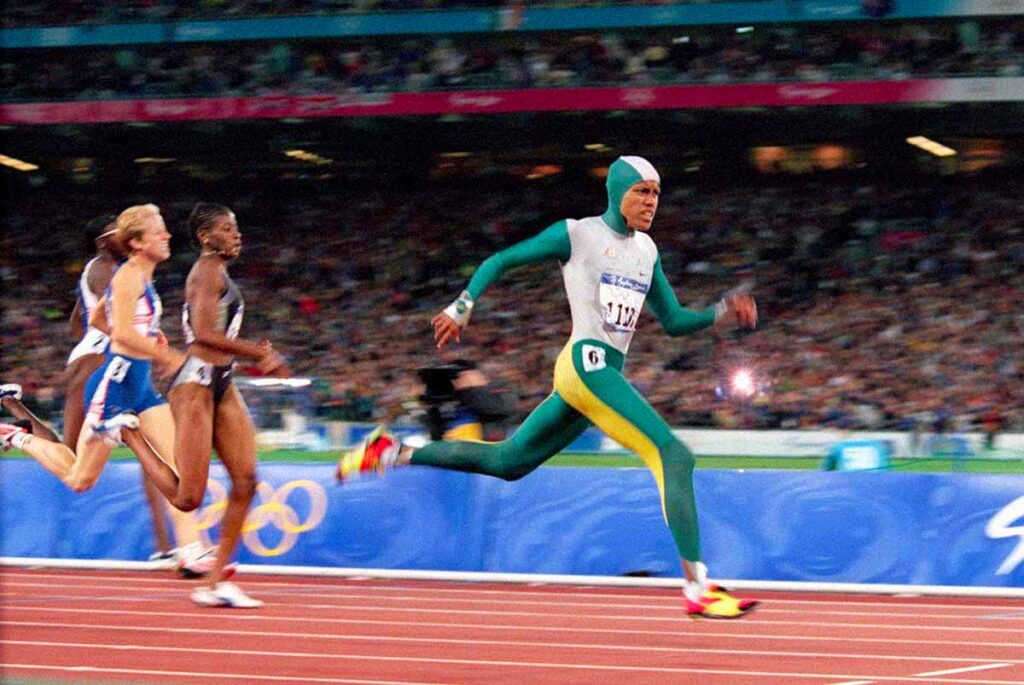
Monday, September 25, 2000: Cathy Freeman wins a gold medal in the Olympic Games in Sydney for the women’s 400 metres.
Cathy Freeman won the hearts of a nation. She is quoted to have said, “I wanted to be an Olympic champion and I didn’t care about the goings-on around me. In my heart and with all of my soul I was ready, willing and I was very able. I had a deadly sense of self-belief. I’d go to another level and say I had a deadly sense of self-conviction where you can say whatever you want, you can do whatever you want but you’re not going to touch me.”.
On the final turn of the race, two other runners were close to her, but she powered away in the straight and won the race by three metres.
World History
Tuesday, September 25, 1956. : The world’s first trans-Atlantic telephone cable system commences operations.
The Trans-Atlantic telephone system opened in 1927. Prior to 1956, however, telephone calls across the ocean had been transmitted via radio waves. Cables, which provided better signal quality, avoided atmospheric interference and presented greater capacity and security, were not used until the first Trans-Atlantic submarine cable commenced operations on 25 September 1956.
While the first transatlantic telegraph cable had been laid in 1858, modifications and technological advances had to be made for it to suit telephonic communications. These advances were not practical until the 1940s. The initial capacity of the cables was 36 calls at a time, costed at $12 for the first three minutes. In the first 24 hours of service, there were 588 London-US calls and 119 from London to Canada. The capacity of the cable was soon increased to 48 channels.
World History
Wednesday, September 25, 1957. : Over 1000 US paratroopers are required to escort nine black students into a previously all-white school.
Civil rights for African-Americans was becoming a prominent issue in the 1950s. In 1954, the United States Supreme Court had granted African Americans the right to an equal education. Early in September 1957, 9 black students were due to enrol in the previously segregated Little Rock Central High School. The governor of Arkansas, Orval Faubus, rallied 270 armed National Guardsmen to prevent the nine students from entering the school.
President Eisenhower deliberated with the governor and the mayor of Little Rock for many days. During this time, there were frequent scenes of racial hatred and prejudice shown by the white community in Little Rock, and fears grew that the tensions would escalate into violence. On 25 September 1957, Eisenhower was forced to send in 1,100 paratroopers to escort the students into the school. Eisenhower federalised the Arkansas National Guard, because as commander-in-chief of the armed forces, he felt this was the only way to establish law and order. For the entire school year, the federalised National Guard remained as a peace-keeping force, and to protect the African-American students.