
Australian Explorers
Monday, February 2, 1829. : Captain Sturt discovers and names the Darling River.
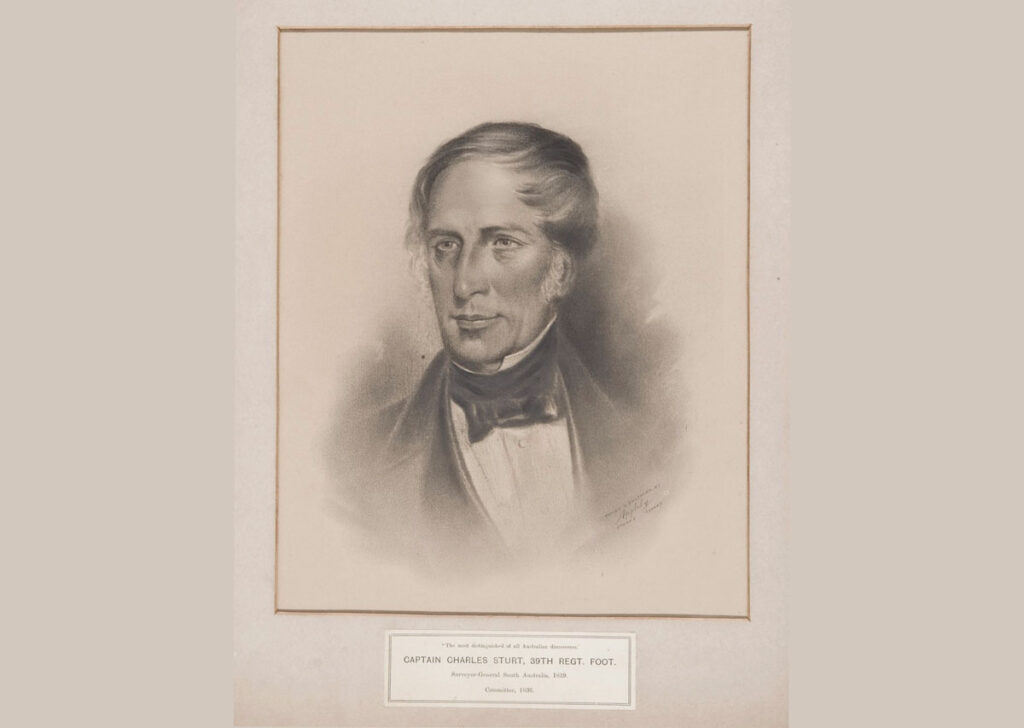
Captain Charles Sturt was born in India in 1795. He came to Australia in 1827, and soon after undertook to solve the mystery of where the inland rivers of New South Wales flowed. Because they appeared to flow towards the centre of the continent, the belief was held that they emptied into an inland sea. Drawing on the skills of experienced bushman and explorer Hamilton Hume, Sturt departed in late 1828 to trace the Macquarie River.
Following the Macquarie inland, they came to a smaller river which, due to the drought, was merely a series of waterholes. This was the Bogan, named after an Aboriginal word meaning “birthplace of a king”. Sturt followed the Bogan downstream past the site of today’s Bourke, until he arrived suddenly at what he described as “a noble river”, on 2 February 1829. This was the Darling, which Sturt named after Governor Darling. The discovery of the Darling brought a new element to the mystery of the rivers: its banks clearly showed that during flood-times, it would carry huge amounts of water. It remained to be determined whether the river drained into an inland sea to the southwest, or whether it flowed elsewhere.
Australian History
Saturday, February 2, 1895. : Queen Victoria gives Royal assent to the Bill allowing South Australian women the right to vote.
Women in South Australia gained the right to vote in 1894, and voted for the first time in the election of 1896. It is generally recognised that this right occurred with the passing of a Bill on 18 December 1894. However, a letter from the Attorney-General advising Governor Kintore that Royal Assent would be required to enact the Bill, is dated 21 December 1894. The Bill was enacted when Queen Victoria gave Royal Assent on 2 February 1895.
South Australia was the first colony in Australia and only the fourth place in the world where women gained the vote. The issue of women voting had been discussed since the 1860s, but gained momentum following the formation of the Women’s Suffrage League at Gawler Place in 1888. Between 1885 and 1894, six Bills were introduced into Parliament but not passed. The final, successful Bill was passed in 1894, but initially included a clause preventing women from becoming members of Parliament. Ironically, the clause was removed thanks to the efforts of Ebenezer Ward, an outspoken opponent of women’s suffrage. It seems that Ward hoped the inclusion of women in Parliament would be seen as so ridiculous that the whole Bill would be voted out. The change was accepted, however, allowing the women of South Australia to gain complete parliamentary equality with men.
World History
Monday, February 2, 1795. : The French Government offers a prize of 12,000 francs to whomever can invent a new way of preserving food.
On 2 February 1795, a prize of 12,000 francs was offered by the French government for the invention of a method to preserve and prevent military food supplies from spoiling. Nicolas Appert was a French chef who experimented with heating food in airtight glass jars, ultimately canning meats and vegetables in jars sealed with pitch. This opened the way for the development of canned foods. Appert’s methods of food preservation involving the packaging of food in sealed airtight tin-plated wrought-iron cans was first patented by Englishman Peter Durand in 1810. Further developments and improvements followed until canned foods became a commonplace item in the late 1800s.
World History
Monday, February 2, 1852. : The world’s first public toilet for men opens.
Public toilets are a much-valued commodity throughout the western world. Travellers and shoppers would be sorely inconvenienced without the ready availability of public toilets, and it is difficult to imagine a time when they were not so easily accessed. Whilst public toilets were known to have existed in the ancient world, they did not operate on modern sewers. After the decline of the Roman empire, public facilities also declined, and with it, general sanitation. After many centuries, it became apparent that sanitation was an issue that needed to be addressed.
The Public Health Act of 1848 called for Public Necessaries to be provided to improve sanitation. As a result, the world’s first modern sewer was established in London in 1850. Within two years, the first on-street public toilet to utilise modern sewers was opened. Located at 95 Fleet Street, London, next to the Society of Art, the convenience was officially opened on 2 February 1852, for the sole use of men. A similar convenience was opened nine days later, on 11 February, at 51 Bedford Street, Strand, London. The toilets consisted of water closets in wooden surrounds, and patrons were charged 2d entrance fee and extra for washing or clothes brushes.
Special Days
Wednesday, February 2, 1887. : Today is Groundhog Day in North America.
Groundhog Day is a traditional festival celebrated in the USA and Canada on February 2 every year. Originating from Pennsylvanian German or Dutch tradition, legend states that one should observe a groundhog’s burrow on this day. If the groundhog emerges and fails to see its shadow because the weather is cloudy, winter will soon end. If, however, the groundhog sees its shadow because the weather is clear, it will return to its hole, and winter will continue for six more weeks. This is because bright clear weather in a North American winter is often associated with very cold temperatures.
The tradition of Groundhog Day originated in Punxsutawney, Pennsylvania on 2 February 1887. This is the date of the first official trek to Gobbler’s Knob, where Punxsutawney Phil, the mascot of Groundhog Day, lives. Numerous other cities and towns have mascot groundhogs, such as Jimmy the Groundhog in Sun Prairie, Wisconsin, and Staten Island Chuck in New York City, General Beauregard Lee in Atlanta, Georgia, Wiarton Willie in Wiarton, Ontario, Shubenacadie Sam in Nova Scotia and Balzac Billy in Balzac, Alberta. While Groundhog Day is observed in both the United States and Canada, it is not a public holiday.
Special Days
Tuesday, February 2, 1971. : Today is World Wetlands Day.
World Wetlands Day, an annual event, marks the date of the adoption of the Convention on Wetlands of International Importance (Ramsar Convention) in Ramsar, Iran on 2 February 1971. The Convention aims to ensure the preservation and effective management of the world’s wetlands. The mission of the Ramsar Convention is “the conservation and wise use of all wetlands through local and national actions and international cooperation, as a contribution towards achieving sustainable development throughout the world”. Wetlands are defined as all lakes and rivers, underground aquifers, swamps and marshes, wet grasslands, peatlands, oases, estuaries, deltas and tidal flats, mangroves and other coastal areas, coral reefs, and all human-made sites such as fish ponds, rice paddies, reservoirs and salt pans. Wetlands are the source of mankind’s fresh water, yet they continue to be subjected to degradation through development, pollution and the exploitation of natural resources.
Like most other habitats, wetlands are vulnerable to the effects of our changing global climate and weather patterns. However, if managed correctly, wetlands can help reduce greenhouse gases through capturing and storing carbon, while providing an example of nature’s adaptation to rising sea levels and associated problems such as flooding and storm surges. Designed to raise public awareness of the importance of wetlands for humanity and for planet Earth, World Wetlands Day was first celebrated internationally in 1997. Since its inception, a range of government and non-government agencies and groups have organised activities to help recognise World Wetlands Day. These have included festivals, wetland rehabilitation events, seminars, nature walks and the announcement of new Ramsar sites.