
Born on this day
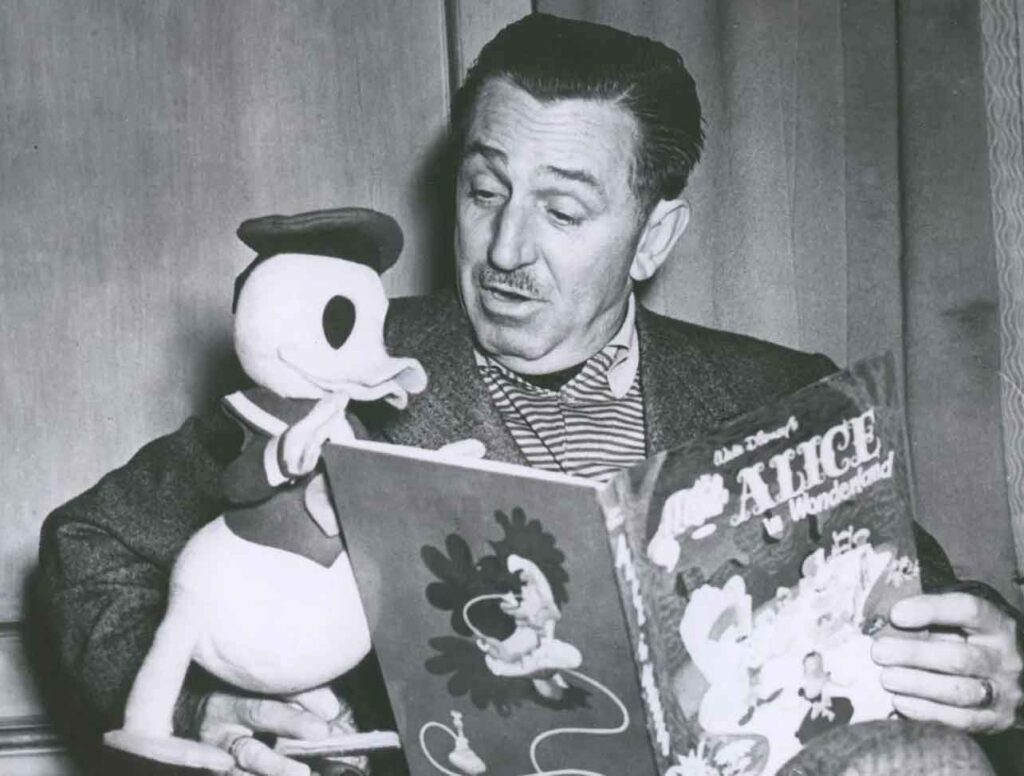
Thursday, December 5, 1901. : American animator and film producer, Walt Disney, is born.
Walter Elias Disney was born in Chicago, Illinois, USA, on 5 December 1901. After serving with the Red Cross Ambulance Corps during World War I, he worked first as a commercial artist, then established his own studio, producing animated cartoons. After the company failed to turn a profit, Disney gained animation experience with the Kansas City Film Ad Corporation, working on primitive animated advertisements for local movie houses. He then established Laugh-O-Grams, Inc, which produced short cartoons based on popular fairy tales and children’s stories. When the company went bankrupt, Disney was invited to join his brother Roy in Hollywood, where they started the Disney Brothers Studio. The Disney Brothers Studio became the Walt Disney Studio in 1926, and then Walt Disney Productions in 1928.
Disney is best known for creating Mickey Mouse and Donald Duck, and for establishing the first theme park, Disneyland, in the USA. Disney currently holds the record for career Academy Award nominations, having gained 64 nominations. Among Disney’s better known animated characters are Winnie the Pooh, Pinocchio and Ariel the Mermaid. Disney died from lung cancer on 15 December 1966.
Australian History
Sunday, December 5, 1909. : George Taylor, little-known pioneer in Australian aviation, achieves the first Australian flight of a heavier-than-air machine.
George Augustine Taylor was born in Sydney on 1 August 1872. As a young man, he trained as a builder and then worked as a cartoonist. However, emerging developments in science and technology began to capture his imagination. In 1908, he established a factory for the purpose of building light aircraft.
As a student and admirer of aviator Lawrence Hargrave, Taylor developed a keen interest in gliding. Inspired by Hargrave’s experiments with flying using a box kite, Taylor built a biplane from coachwood, covered with oiled calico, and with a box-kite tail for balance. On 5 December 1909, together with Edward Hallstrom (later known for his developments in the manufacturing industry rather than his aviation achievements), Taylor launched his glider from the sandhills at the northern Sydney beach of Narrabeen, thus pioneering gliding in Australia. He conducted more than 20 flights that day, varying in distance from 100 to 250 metres, at heights ranging from 1 to 3 metres above the sand. Taylor’s wife, Florence, also tried her hand at gliding that day, becoming the first woman to fly in Australia. She later complained that her biggest problem was her clothes, and having to tuck in her skirts as she flew.
Taylor went on to be an architect, engineer, founder and Secretary of the Australian Air League, and cartoonist for Bulletin and Punch magazines. He also founded the Wireless Institute of Australia, contributing much to the spread and development of wireless technology in Australia.
World History
Tuesday, December 5, 1933. : Prohibition in the United States ends.
Prohibition generally refers to the time between 1920 and 1933 during which the Eighteenth Amendment was in place. The Eighteenth Amendment, forbidding the “manufacture, sale, or transportation of intoxicating liquors for beverage purposes,” was passed by Congress and ratified on 16 January 1919. The ensuing Volstead Act, which made provisions for the enforcement of the Eighteenth Amendment, was passed on 28 October 1919.
Prohibition failed to enforce sobriety, and the federal and state governments lost billions in tax revenue. In 1933, the 21st Amendment to the Constitution was passed and on 5 December 1933, Utah became the 36th state to ratify the amendment, achieving the required three-quarters majority of states’ approval. Whilst this ended national Prohibition, some individual states continued to uphold their own temperance laws. Mississippi, for example, was the last state to end Prohibition, doing so only in 1966.
World History
Friday, December 5, 1952. : The Great Smog of London starts, lasting until March of 1953.
London has long been known as a city of fog and pollution, a combination which turned deadly on 5 December 1952. November 1952 had been considerably colder than average, with heavy falls of snow in southern England. Londoners had already been burning more coal than usual for heating. Being the end of Autumn, the city was also converting from using electric trams to diesel-burning public transport. The formation of an atmospheric inversion meant that the layer of cold fog filled with dirty particles was trapped by warmer air above. The smog was so thick that it reduced visibility for drivers, and Heathrow Airport was closed. The smog entered indoors as well, causing the cancellation of concerts, theatrical performances and even films, as the audience could not see the stage or screen.
Around 4,000 people died during the first week, mostly the very young, elderly and those already suffering from respiratory problems. However, as the weeks dragged on and the smog hung around, the death toll continued, with another 8,000 dying before the smog finally lifted the following Spring, in March 1953. The Great Fog altered perceptions regarding the dangers of London’s “pea-souper” fogs. Whereas Londoners had always been complacent about their smog, new regulations were put in place restricting the use of dirty fuels in industry and banning black smoke. These included the Clean Air Acts of 1956 and of 1968, and the City of London (Various Powers) Act of 1954.
World History
Thursday, December 5, 2013. : Nelson Mandela, anti-apartheid campaigner and the first democratically-elected President of South Africa, dies.
Nelson Rolihlahla Mandela was born on 18 July 1918. Rolihlahla Mandela was seven years old when he became the first member of his family to attend school: it was there that he was given the English name “Nelson” by a Methodist teacher.
In his university days, Mandela became a political activist against the white minority government’s denial of political, social, and economic rights to South Africa’s black majority. He became a prominent anti-apartheid activist of the country, and was involved in underground resistance activities. Although interred in jail from 1962 to 1990 for his resistance activities, including sabotage, Mandela continued to fight for the rights of the South African blacks. He was eventually freed, thanks to sustained campaigning by the African National Congress, and subsequent international pressure. He and State President F.W. de Klerk shared the Nobel Peace Prize in 1993. Mandela was elected to the Presidency of South Africa in 1994. He retired in 1999, and died at his home in Johannesburg on 5 December 2013.