
Australian Explorers
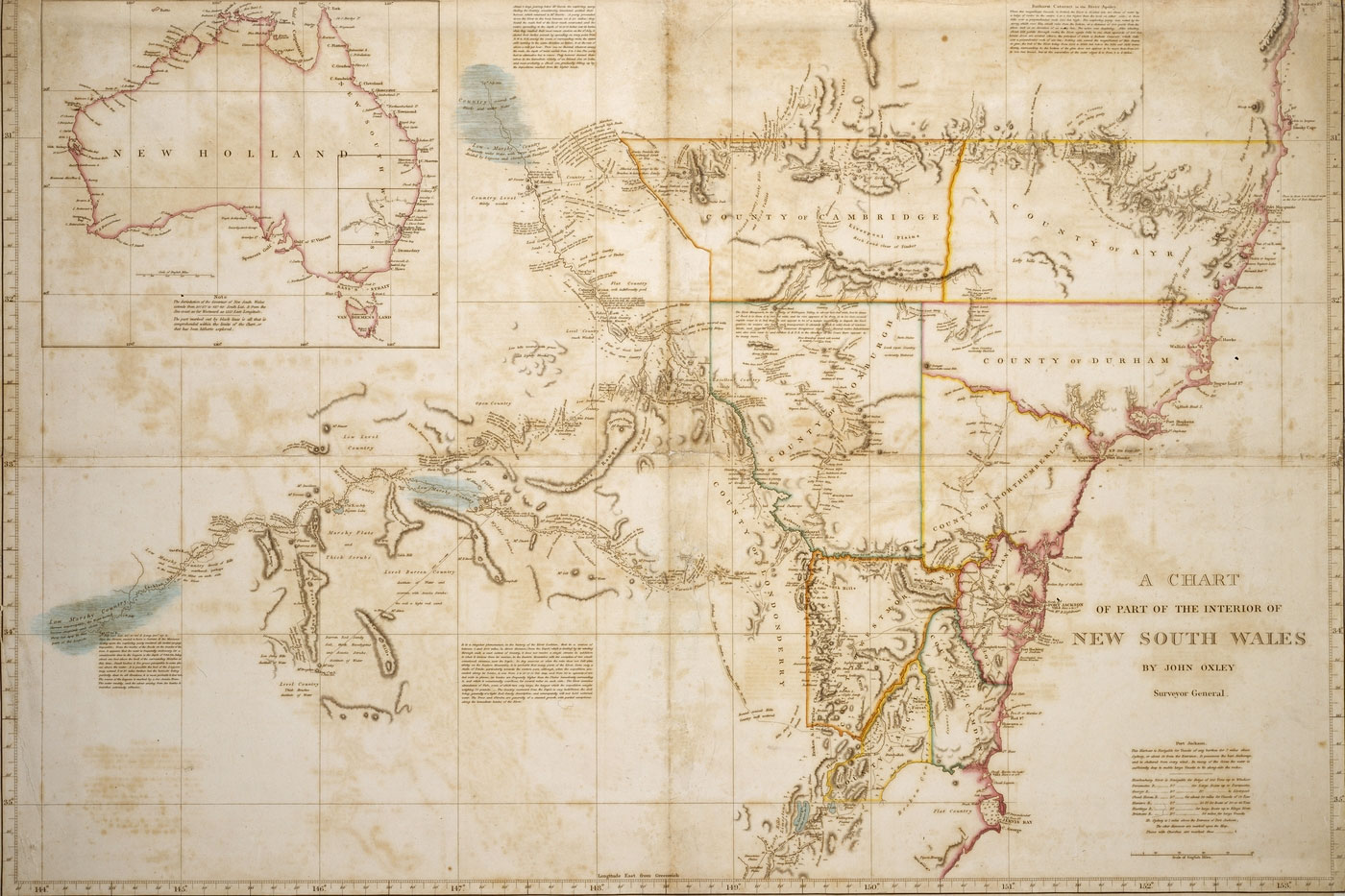
Tuesday, December 2, 1823. : Oxley sights the entrance to the Brisbane River.
John Joseph William Molesworth Oxley was one of Australia’s early explorers. An experienced seaman who arrived in Australia in 1802, Oxley was appointed Surveyor-General in 1812, and immediately undertook a series of explorations inland from Sydney.
In 1823, Oxley set sail from Sydney to travel north along the coastline. His aim was to find a suitable settlement for convicts who had not been reformed, but continued to re-offend. Reaching Port Curtis (Gladstone), Oxley rejected the harbour as unsuitable, due to its many shoals and mangrove swamps. Oxley returned south and entered Moreton Bay, where he anchored off Pumicestone Channel, now Pumicestone Passage, on 29 November 1823.
From here, Oxley set out in a smaller boat to chart the western shores of Moreton Bay. On 2 December 1823, he came across the entrance to the Brisbane River, which ticket-of-leave convict timber-getters Parsons, Pamphlett and Finnegan had already discovered by accident. Naming it after New South Wales Governor, Sir Thomas Brisbane, Oxley surveyed the river for approximately eighty kilometres. Following his enthusiastic report on the river, a convict settlement was established at Moreton Bay in 1825.
Australian Explorers
Saturday, December 2, 1911. : Douglas Mawson departs Hobart to commence his Antarctic exploration.
Australian Antarctic explorer, Douglas Mawson, was born on 5 May 1882, in Yorkshire, but his family emigrated to Australia in 1884. He studied geology at Sydney University, and was appointed geologist to an expedition to the New Hebrides in 1903. After this, he returned to Australia to become a lecturer in petrology and mineralogy at the University of Adelaide in 1905. In 1907, Mawson joined an expedition to Antarctica led by Ernest Shackleton, as a scientific officer, and was one of the first to ascend Mount Erebus and get close to the South magnetic pole. He was offered a place on Robert Scott’s Terra Nova expedition but turned it down to lead the Australasian Antarctic Expedition of 1911-1914, sailing on the “Aurora”.
On 2 December 1911, Mawson departed from Hobert on the “Aurora”, bound for Macquarie Island, a sub-Antarctic island 1500 kilometres southeast of Tasmania and 1300 kilometres north of Antarctica. Here, he established a base before leaving on December 23 to explore the Antarctic continent.
Australian History
Tuesday, December 2, 1642. : Members of Tasman’s crew become the first Europeans to set foot on Van Diemen’s Land (later renamed Tasmania).
Abel Janszoon Tasman was a Dutch seafarer and explorer who, as an employee of the Dutch East India Company, was ordered to explore the south-east waters in order to find a new sea trade route to Chile in South America. In November of 1642, he discovered a previously unknown island on his voyage past the “Great South Land”, or “New Holland”, as the Dutch called Australia. He named it “Antony Van Diemen’s Land” in honour of the High Magistrate, or Governor-General of Batavia.
On 2 December 1642, several members of Tasman’s crew were sent in two boats to a bay to seek “fresh water and other things.” They became the first known Europeans to set foot on Van Diemen’s Land (which later became known as Tasmania). The men collected green plants, including sea parsley, or wild celery, to help ward off scurvy among the sailors. They also noted the presence of indigenous people, though they did not actually see them. They observed tall trees with steps cut in the trunks, trees scorched by fire, smoke rising in several locations and the far-off sound of music. Ship’s master, Francis Jacobsz, also became the first to observe the existence of the Tasmanian Tiger. Though he did not see an actual Thylacine, he noted tracks “with claws resembling those of [tygers]”.
Australian History
Wednesday, December 2, 1970. : The numbat is officially listed as endangered.
The numbat is a small, striped marsupial of Western Australia, and the faunal (animal) emblem of that state. Sometimes known as the banded anteater, it feeds almost exclusively on termites, and is Australia’s only marsupial to do so. The numbat is unusual for several reasons; it is one of Australia’s very few diurnal marsupials, and it does not have a full abdominal pouch, but rather an open pouch which lends little protection to the young which cling to the mother’s underbelly while attached to the teat.
Numbats used to be widespread across the southern half of the continent, but numbers have declined severely since the beginning of European settlement in Australia. Numbats are now restricted to just a few areas of southwestern Western Australia. The introduction of predators such as cats, dogs and foxes have had a severe impact on numbat populations, as has land clearing for agriculture and changed fire regimes. Current figures estimate there are only about 1500 adult numbats remaining.
The numbat was officially listed as endangered on 2 December 1970. Since that time, the Department of Environment and Conservation of Western Australia has established several programmes to try and ensure the continued survival of this delicate and defenceless marsupial. In the 1980s, Perth Zoo also commenced a captive breeding programme for the purpose of releasing numbats back into protected wildlife reserves.
World History
Sunday, December 2, 1804. : Napoleon Bonaparte crowns himself Emperor of France.
Napoléon Bonaparte was born Napoleone Buonaparte in Ajaccio, Corsica, on 15 August 1769. His father, Carlo Buonaparte, was an attorney and Corsica’s representative to the court of Louis XVI of France in 1778, so Napoleon later adopted a more French form of his name. He began his military career at the age of 16, and rapidly advanced through the ranks. Famed for being an excellent military strategist, he deposed the French Directory in 1799 and proclaimed himself First Consul of France. His military forays into Europe were highly successful, and by 1807 he ruled territory stretching from Portugal to Italy and north to the river Elbe. Napoleon crowned himself Emperor of France on 2 December 1804, at Notre-Dame Cathedral.
Despite Napoleon’s military successes, he failed in his aim to conquer the rest of Europe. He was defeated in Moscow in 1812 in a move which nearly destroyed his empire, and his 1815 loss to the Duke of Wellington at Waterloo resulted in his exile to the island of St Helena, where he died in 1821. However, his codification of laws, the Napoleonic Code, remains the foundation of French civil law.